History of Typography: Past
Movable Type
In the beginning, scribes were manufacturing books or documents by hand. The first typefaces were modeled on forms of calligraphy to mimic the handwriting of scribes.
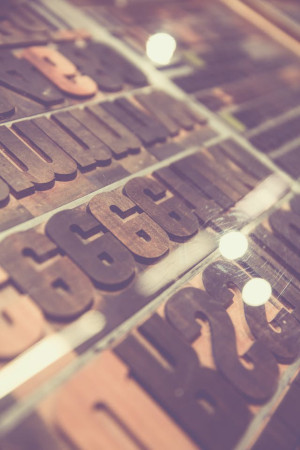
Movable type was invented by Johannes Gutenberg in Germany in the early 15th century. The Gutenburg Bible was the earliest major book printed in Western Europe from movable type.
Moveable type revolutionized writing as printing with type allowed for mass production of printed items. Large quantities of letters could be cast from a mold and assembled into forms.
Humanists and Lettera Antica
Later in the 15th century, humanist writers and scholars rejected the original gothic scripts and favored a more classic, open way of writing called lettera antica.
We owe a great debt to the Humanists as it was the script they created that became the model for small letters. The renaissance practice and analysis during this period of time was also applied to type- making a more mathematically perfect (rationalized) letter.
Some humanist typefaces are still in use today: Garamond, Bembo, Palatino, and Jenson.

Advertisements and Monster Fonts
With the rise of industrialization and mass consumption in 19th century, advertisements came which created a new form of communication… and the need for new kinds of typography.
Type designers created big, bold type faces by embellishing or exaggerating letters and their parts. Fonts appeared which broke the conventions of height, width, and depth. Fonts began being cut from wood to print at larger scales and, when combined with a tracing device and router, many variants could be made for each letter.
Typography became an elastic system of letter features (weight, stress, serifs, angles, curves, etc.) and the relationship between letters became important.
Reform and Revolution
In the early 20th century, some typographic designers began to reject the exaggerated typefaces that arose during the 19th century as a part of industrialization and advertisements, They began looking for uncorrupted letter forms and referred to the Renaissance period for inspiration.
These reformers were attached to history but they created a new definition for typographic designers as intellectuals/scholars detached from the commercial mainstream meaning they were defined outside of the consumerism needs.
Outside of the reformers, typefaces continued to be produced, but with a emphasis on function over form with the popular Futura font being created in 1927 and is still used to this day.
Type in the Digital Age
The rise of electronic communication and personal computers brought on a new font production method: video screens. On these screens, curves and angles rendered as straight lines and original typefaces of this period leaned into the straight line or dot which presented well on these screens.
In the early 1990s, digital design tools began allowing digital reproduction and integration of different types of media. This brought on a wave of new experimentation: producing typefaces which were warped, bent, and imperfect.
Existing typefaces were combined (Dead History), typefaces gained new sources of inspiration (Template Gothic), and new productions methods entered the field (Beowulf, the first programmed typeface).
